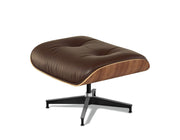
Designed in 1956 by the legendary design partnership of Charles and Ray Eames, the Eames Ottoman is the inseparable companion to the Eames Lounge Chair. Together, they form what is arguably the most famous and highly coveted furniture configuration of the 20th century. Conceived as a modern take on the traditional English club chair, this ottoman was designed to give luxurious, weightless comfort to the feet and legs, elevating relaxation into a profound design experience. When Charles and Ray set out to design the lounge chair and ottoman, they wanted it to have the "warm, receptive look of a well-used first baseman's mitt." The Eames ottoman is a masterclass in structural continuity. It utilizes the exact same material blueprint as the chair's seat shell, echoing its lines perfectly so that the two pieces flow into one another seamlessly. To maintain absolute structural elegance, the ottoman is engineered with a fixed inclination angle that naturally distributes leg pressure, promoting optimal circulation while you recline.
Made in Italy
Usually ships within 4 weeks
Free shipping
ADDITIONAL INFORMATION
Dimensions:
- Height 76 cm (17.2")
- Width 76 cm (26")
- Depth 79 cm (21.5”)
Materials:
- Molded Playwood
- Aluminium
- Cover in leather
General Information:
- Living room
- Hotel room
- Indoor use
The legacy of the Bauhaus is truly remarkable, isn't it? Its approach to integrating art, craft, and technology has left an indelible mark on various design disciplines. Here's a bit more detail on some of the iconic pieces and their designers you mentioned:
1. Wassily Chair by Marcel Breuer: This chair, with its innovative use of tubular steel, was revolutionary for its time and remains a design classic. 2. Barcelona Chair by Mies van der Rohe: Known for its sleek lines and luxury materials, this chair epitomizes modern elegance. 3. Cesca Chair by Marcel Breuer: Combining a tubular steel frame with a caned seat and back, this chair is celebrated for its simplicity and comfort. 4. Table Bauhaus by Marcel Breuer: This table, like many of Breuer's designs, showcases the clean lines and functional forms that are hallmarks of the Bauhaus aesthetic.
The Bauhaus' influence extends beyond furniture; it has shaped graphic design, typography, and architecture, pushing the boundaries of what's possible and encouraging a minimalist yet functional approach.